
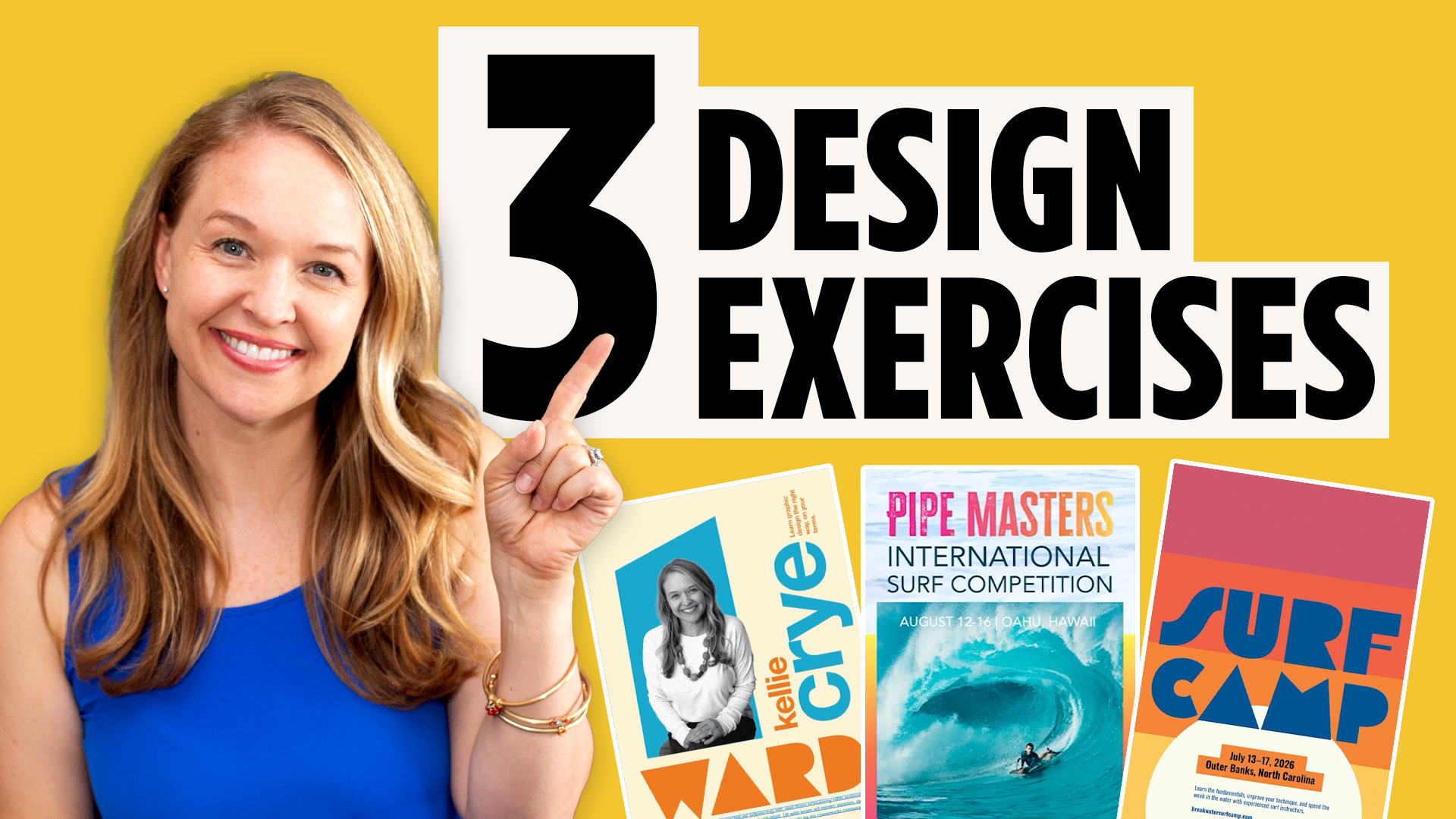
If you’ve ever wondered how to become more creative as a graphic designer, the answer probably isn’t another software tutorial or another hour scrolling through Pinterest. Creativity comes from learning to recognize why good design works—and practicing those decisions yourself. If you want a structured way to strengthen your process, you can also grab my free Project Brief Template and use it while working through the exercises below.
You don’t need to wait for inspiration to magically appear.
You can actually train your creative eye.
The more you understand typography, hierarchy, composition, color, imagery, and spacing, the easier it becomes to make confident creative decisions in your own work.
Here are three exercises you can start using today.
How to Become More Creative as a Graphic Designer by Analyzing Good Design
The first exercise sounds simple: find three designs you genuinely love.
But don’t just save them to an inspiration board and move on.
Slow down and ask yourself why each design works.
Look at the typography. Where does your eye go first? What creates hierarchy? How is color being used? How are the elements aligned? What makes the composition feel balanced or energetic?
Imagine you’re looking at a jazz poster with a large orange circle, a black-and-white portrait, angled typography, and an oversized musician’s name.
Instead of saying, “I like this,” dig deeper.
Maybe the orange circle immediately grabs your attention. A saxophone leads your eye across the composition. Large type establishes hierarchy, while angled text creates movement that feels appropriate for the energy of a jazz performance.
Those observations matter.
When you can explain why a design works, you’re doing more than collecting inspiration. You’re beginning to understand the decisions behind the work.
And that is how you start developing your design eye.
Exercise 2: Recreate a Design You Admire
Looking closely at good design is valuable.
Rebuilding it is even better.
Choose one design you admire and recreate it as closely as possible in Illustrator, Photoshop, Figma, Canva, Affinity, or whichever design tool you’re learning.
This isn’t about copying someone’s work and claiming it as your own. It’s a learning exercise.
When you rebuild a design piece by piece, you’re forced to notice decisions you may have completely missed while simply looking at it.
How large is the headline compared with the supporting copy?
How much space sits between elements?
Where are objects aligned?
Why does one typeface work better than another?
How much of the composition is occupied by imagery versus negative space?
You’re essentially reverse engineering another designer’s thinking.
Start with the largest shapes and major areas of color. Then add typography, imagery, and smaller details.
As you work, pay attention to scale and relationships between elements rather than simply trying to make everything “look right.”
That process teaches you something a software tutorial often can’t: how individual design decisions work together to create a complete composition.
Exercise 3: Create Three Solutions to One Design Brief
The third exercise takes what you’ve learned and asks you to create something original.
Start with one design brief and create three completely different design directions.
For the first version, make typography the dominant element.
For the second, create an image-driven solution using photography or illustration.
For the third, give yourself permission to experiment. Use shapes, gradients, unusual typography, illustration, or a combination you normally wouldn’t try.
Most importantly, don’t try to perfect all three.
The goal is idea generation.
For example, if you were designing a poster for a fictional surf camp, your image-driven concept might feature a large photograph filling most of the page.
Your typography-driven concept could use an expressive typeface and blocks of color that suggest a sunset.
Your third concept might combine a large photograph with a gradient or unexpected graphic treatment.
Same problem. Three very different answers.
That ability to explore multiple solutions is one of the most important creative skills a designer can develop.
Your first idea usually isn’t your strongest idea.
Iteration gives you options—and options give you the ability to compare, refine, and make better design decisions.
Creativity Is a Skill You Can Practice
Learning how to become more creative as a graphic designer isn’t about constantly searching for more inspiration.
It’s about becoming more observant.
Analyze strong design until you can explain why it works. Recreate designs to understand the decisions hiding beneath the surface. Then practice creating several solutions to the same problem.
Over time, those decisions become easier to recognize and easier to make yourself.
That’s when inspiration starts turning into actual design skill.
Try these three exercises this week: analyze three designs you admire, recreate one of them, and create three different directions for one design brief.
You might be surprised by how much more you notice the next time you sit down to design.
And if you’re serious about learning how to become more creative as a graphic designer, keep practicing the why behind every choice—not just the software steps.
🎁 FREE RESOURCES FOR DESIGNERS
- 👉 Try Canva Pro free for 30 days → https://partner.canva.com/kOARLL
- ☕️ Start your 7-day free Adobe Creative Cloud trial → https://adobe.prf.hn/click/camref:1101lKN6K
- 🎨 Shop my favorite design & creator tools → https://amzn.to/4tAYQwN
- Logo Design Workbook — https://cryestudio.systeme.io/logo_design_workbook
- Logo Export Cheat Sheet + Template — https://cryestudio.systeme.io/logoexporttemplate
Want to keep improving your design skills? Download one of the free CryeStudio design resources above and put these exercises into practice on your next project. You can also try the recommended Canva and Adobe tools to turn what you’re learning into real design work.